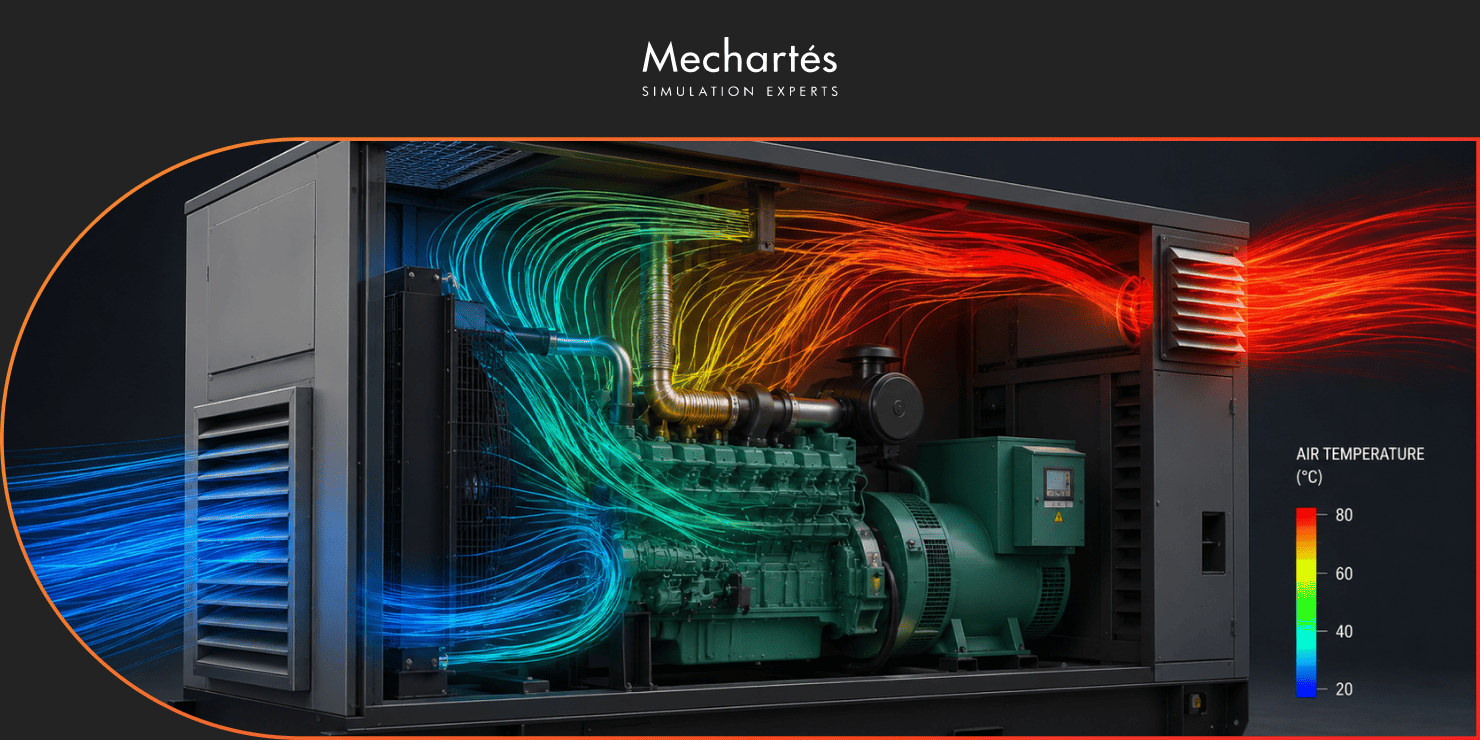
A generator enclosure has two jobs that tend to pull against each other. It has to protect the equipment inside from weather and noise, and keep it cool enough to run reliably. In high-ambient environments, closing up the enclosure to meet the first requirement makes the second one harder.
The engine, alternator and radiator all throw off heat while the generator runs. If that heat isn’t removed fast enough, the unit doesn’t fail outright so much as quietly deliver less than it should, running at reduced output or shutting down when you need it most. That’s the problem CFD analysis catches before it reaches site.
At Mechartes, we use CFD analysis to check enclosure airflow before it’s built, across projects in infrastructure, power and data centre work. The study traces how air moves through the intake, around the equipment, and out through the exhaust, and checks whether the enclosure stays within its design temperature range under peak load.
On paper, ventilating a generator enclosure sounds simple: bring cool air in, push hot air out. In practice, the air works through several stages first, including intake louvers, sand traps, filters and attenuators. Each one adds resistance and reshapes how airflow distributes inside the enclosure.
Most project briefs come down to verifying a handful of things. The ventilation system needs to:
The exact configuration varies by project, but most combine some mix of: fresh air intake louvers, often paired with sand trap louvers and filtration in dusty or coastal environments; intake air filters, walkable gratings or plenums; intake and discharge sound attenuators for acoustic compliance; motorised intake and discharge louvers; axial ventilation fans working alongside the generator’s own radiator fan; and weather louvers or discharge shafts on the exhaust side.
Ambient air enters through the intake, passes through filtration and acoustic treatment, and flows around the generator unit. Heat gets carried away by the combined pull of the radiator fan and the ventilation fans, and the warmed air is pushed out through the exhaust path.
Where the enclosure also houses an electrical room (control panels, distribution boards and similar equipment), we extend the CFD analysis to check that room’s air-conditioning is sized correctly too, since it doesn’t always get the same attention as the main ventilation path.
With the 3D model and boundary conditions in place, the simulation answers a specific set of questions: airflow distribution throughout the enclosure, not just at the intake and exhaust openings; temperature distribution under full load; how effectively the ventilation removes heat from the engine, alternator and radiator; whether there are hot spots or recirculation zones, where hot air gets pulled back into the airflow path (the same failure mode we flag in chiller yard studies, just inside a smaller footprint); pressure drop across the full path; and whether the design meets the project’s thermal and airflow criteria, and where it doesn’t.
A ventilation study like this is really about confidence before commissioning. Once the CFD analysis confirms the enclosure holds temperatures within the required range under peak load, commonly 55°C or below for the equipment areas, though the exact threshold depends on the project and equipment ratings, that’s one less variable to worry about on site. Airflow paths and heat removal get verified before anything is fabricated, much like we validate external yard airflow or chiller inlet recirculation ahead of construction.
Generator enclosures rarely get the same design scrutiny as data halls or chiller yards, but the failure mode is the same: equipment that can’t deliver when it’s needed most, which for a generator is almost always during a grid outage. It isn’t glamorous, but it’s usually the cheapest insurance on the whole job, whether it’s a standalone genset or part of a wider generator CFD analysis scope on a data centre site, or any enclosed space where ventilation and air quality are closely linked.
It’s also the kind of verification we run before any generator enclosure design gets signed off. If you have a design that needs checking before fabrication, get in touch with our team.