
 0
0
 Share
Share 
ANSYS Mechanical is FEA software used to simulate how a product responds to real-world forces, vibration, heat, and fluid flow, without needing a physical prototype. It runs fast parallel solvers, handles nonlinear material behavior, and includes acoustics analysis, which is why it’s one of the most widely used tools for mechanical simulation.
Simulation has become indispensable for design and problem-solving as engineering has evolved. Among the computational tools available, Finite Element Analysis (FEA) stands out for its precision and versatility. This article looks at ANSYS Mechanical specifically: what it does, how it uses FEA, and where it fits into mechanical simulation work.
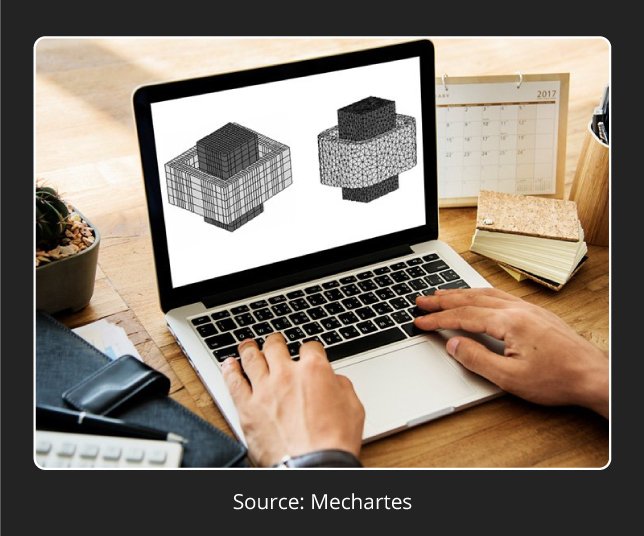
ANSYS, Inc. is an American multinational company that develops and markets CAE/multiphysics engineering simulation software for product design, testing, and operation. It offers its products and services to customers worldwide. It helps engineers design complex, highly nonlinear, and large models and is used to simulate computer models of structures, electronics, or machine components for analyzing strength, elasticity, and temperature.

ANSYS software offers a wide range of features and benefits:
Fast Simulations: ANSYS software includes multiple solver technologies that run in parallel and scale efficiently up to 1000+ cores. GPU technology can also be leveraged for additional parallel computing power.
Linear Dynamics: Modal, harmonic response, random vibration, and spectrum response (seismic or shock) can be solved with ANSYS Mechanical.
Acoustics: ANSYS software conducts acoustic simulations to better understand systems’ vibroacoustic behavior.
Nonlinearities: Users can simulate the behavior of elastic materials as they undergo plastic or hyperelastic deformation materials like metals and rubber. Nonlinear simulation within ANSYS Mechanical design also considers contact and large deflection of moving parts relative to each other, with or without friction.
Short Fiber Reinforced Composites Workflow: ANSYS software enables engineers to accurately and easily simulate plastic parts made through injection molding. The injection process data, including fiber orientation and density details, are imported and mapped seamlessly onto a finite element mesh in Mechanical and complemented with accurate material behavior at each element.
Back to CAD Workflow: This new workflow allows users to turn their topology optimization results into computer-aided design (CAD) geometry. The “autoskin” feature saves the user time otherwise spent on recreating geometry.
Finite Element Analysis (FEA) is a numerical method for predicting how a product or a structure will react to physical forces, such as vibration, heat, fluid flow, etc. It uses the finite element method (FEM), which divides the region of interest into smaller parts called finite elements. The method also applies a chosen approximation over each element to determine its behavior.
Three governing equations form the basis for finite element analysis:
Equilibrium Equations
Strain-Displacement Relations
Constitutive Equations (Hooke’s Law)
FEA is important because it allows engineers to simulate a design without building a physical model. Using finite elements allows for modeling multiple material types, testing complicated geometry, and recording local effects acting on a limited design area.
Applications of FEA include:
Simulating physical phenomena and reducing the need for physical prototypes
Optimizing components as part of the design process of a project
Anticipating potential design flaws and lowering the risk to the product
Testing the influence of various situations on the design (stress, vibration, buckling, fatigue, creep, heat, and so on)
Estimating structural behavior and strength, design optimization, modeling, and simulation in various engineering disciplines
Piping design where rigidity is a governing factor
ANSYS uses FEA solvers to customize and automate solutions for structural mechanics problems and analyze multiple design scenarios. ANSYS Mechanical is a dynamic tool with a complete range of analysis capabilities, from preparing geometry for analysis to connecting additional physics for even greater fidelity.
ANSYS offers several benefits when used for FEA, including:
Imports various geometric shapes from different CAD software and use them to perform simulations.
Removes the need for a physical prototype, which can be tested for adverse circumstances.
Tests the product’s behavior in response to different inputs.
By reducing costs and the time taken to produce their products, ANSYS software ensures the efficiency of a company in this competitive world.
We, at Mechartes, an Engineering & IT Services company, were founded in 2004 and possess significant expertise in using ANSYS software to address client challenges. Our organization is made up of highly qualified engineers with domain expertise in Mechanical and Software Engineering.
We utilize ANSYS software for Computational Fluid Dynamics (CFD) and Finite Element Analysis (FEA), among other tools. We have developed a CFD solver, MechFlow, built upon the OpenFOAM library, which will soon be integrated with other Building Energy Simulation (BES) tools. Additionally, we have honed the capability for seismic analysis using tools like NX-Nastran.
Our proficiency with ANSYS enables us to simulate complex systems with notable ease. These simulations are crucial in designing fundamentally efficient, safer, and more effective systems. However, we always stress the importance of thoroughly understanding the physics behind the simulation and the mathematics it employs to ensure accurate results.
Since our inception, Mechartes has witnessed robust growth. The fact that clients continually return to us, with a significant portion of our business being repeat business, is a testament to our expertise and the satisfaction we provide to our customers.
Our advanced methods, simulation algorithms, computing prowess, and over 20 years of experience empower us to deliver precise simulation outcomes with a professional demeanor and an engineering mindset.
It’s used to simulate how mechanical components and systems respond to forces, vibration, heat, and fluid flow, so engineers can test designs virtually instead of building physical prototypes.
Equilibrium equations, strain-displacement relations, and constitutive equations, also known as Hooke’s Law. These three form the mathematical basis for how FEA calculates behavior under load.
ANSYS solvers scale efficiently up to 1000+ cores, and GPU technology can add further parallel computing power for faster results.
Yes. ANSYS Mechanical can simulate elastic materials undergoing plastic or hyperelastic deformation, including contact and large deflection between moving parts.
It removes the need to build and test physical prototypes, lets engineers test product behavior under different inputs, and reduces both cost and time to bring a design to market.
ANSYS software, particularly in the context of Finite Element Analysis (FEA), has revolutionized the world of mechanical simulations. It empowers engineers and designers to virtually test and analyze complex mechanical systems precisely and efficiently, eliminating the need for costly physical prototypes. The software’s array of features, such as fast simulations, nonlinear capabilities, and acoustics analysis, makes it an indispensable tool for a wide range of engineering applications.
In the dynamic world of engineering and product development, ANSYS FEA, coupled with the exceptional services of organizations like Mechartes, continues to drive innovation and efficiency, ultimately leading to safer and more effective engineering solutions..
For inquiries or to harness the power of ANSYS for your engineering needs, feel free to contact us at Mechartes. Your innovative solutions are just a click or call away.
0
Share  facebook