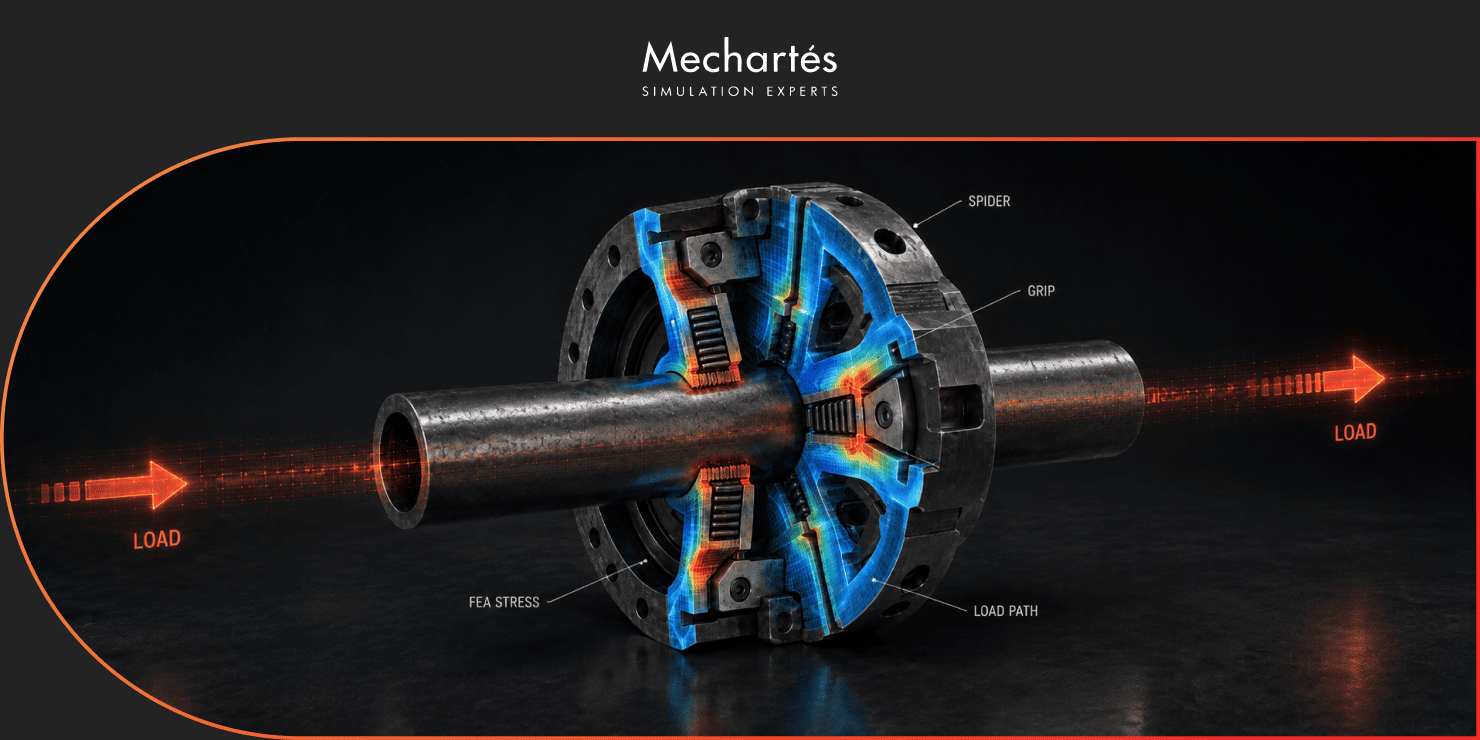
In engineering, validation is always the strategy. That’s the thinking behind a recent project at Mechartes, where we assessed the structural integrity of a flush-mounted spider assembly operating under demanding load conditions.
Ribs, slips and dies work together to grip and hold under load, and every one of those parts has to perform exactly as intended, every time it’s used. A design that merely looks adequate on paper isn’t good enough here. That’s why structural validation on equipment like this tends to fall to specialist FEA companies, not a generic check run by whoever’s available.
The system had 10 sets of interconnected components, each made up of a rib, a slip, and dies. That level of complexity, combined with how critical this equipment is in service, meant conservative assumptions alone weren’t going to cut it. With ten sets of parts all interacting under load, a single hand-calculated margin applied across the board risks masking exactly the kind of localized failure that a proper simulation is meant to catch.
Conservative margins work when a component behaves predictably in isolation. A flush-mounted spider assembly doesn’t offer that luxury. Ribs, slips and dies all transfer load between each other, and how that load moves through the assembly depends on contact, fit, and the specific combination of forces acting at any given moment. This is precisely the kind of problem finite element analysis exists for, where the interactions between parts matter as much as the parts themselves.

We evaluated each component under multiple load combinations, incorporating realistic boundary conditions and contact interactions with real contact and fit conditions built into the model from the start, not stripped out to make the run simpler. That approach let us map load paths through the assembly, identify critical stress locations, and confirm the assembly could safely withstand its operating conditions.
FEA on projects like this goes well beyond generating stress contours. For a complex assembly with interacting components, it delivers a few things a simplified check can’t:
Modelling the contact between the rib, slip and dies in each of the ten sets wasn’t a formality. Contact behaviour changes how load transfers between parts, and in an assembly this interconnected, a stress concentration in one set can look very different once its neighbours are accounted for. Capturing that interaction is what lets the analysis map real load paths through the assembly, the same reasoning behind our broader FEA services for oil and gas equipment.
Finding a design problem after fabrication almost always costs more than the analysis that would have caught it beforehand, the kind of work our FEA consultants run before a design ever reaches the shop floor. Most clients who’ve been through that once don’t need convincing the second time. Rework at that stage isn’t just the cost of remaking a part, it’s schedule slippage, requalification, and in some cases a root cause investigation into a failure that a design-stage check would have flagged.
The four points above aren’t abstract either. They’re what separates a design that clears a single load case from one that’s been tested against the range of conditions it will actually see in service, which is the whole point of running FEA on an assembly this interconnected in the first place.
What FEA actually delivers is confidence going into fabrication without caveats, backed by documentation that shows exactly why a design holds. That’s the same standard we apply across our broader engineering services work, whether the assembly in question is a spider, a pressure vessel, or anything else where interacting components carry real consequences if the analysis gets skipped.
For this assembly, that meant checking each of the ten rib-slip-die sets against combined tension, bending and contact pressure, not just the single load case an assembly is nominally rated for. FEA showed which sets carried disproportionate load once contact stiffness and clearance were modelled properly, something a hand calculation applied evenly across ten near-identical sets would have missed. That’s what an FEA study adds on equipment like this: it tells you where the real margin sits, set by set.
If you’re working through a similar structural assessment or a complex assembly that needs validating before fabrication, get in touch with the team at Mechartes.