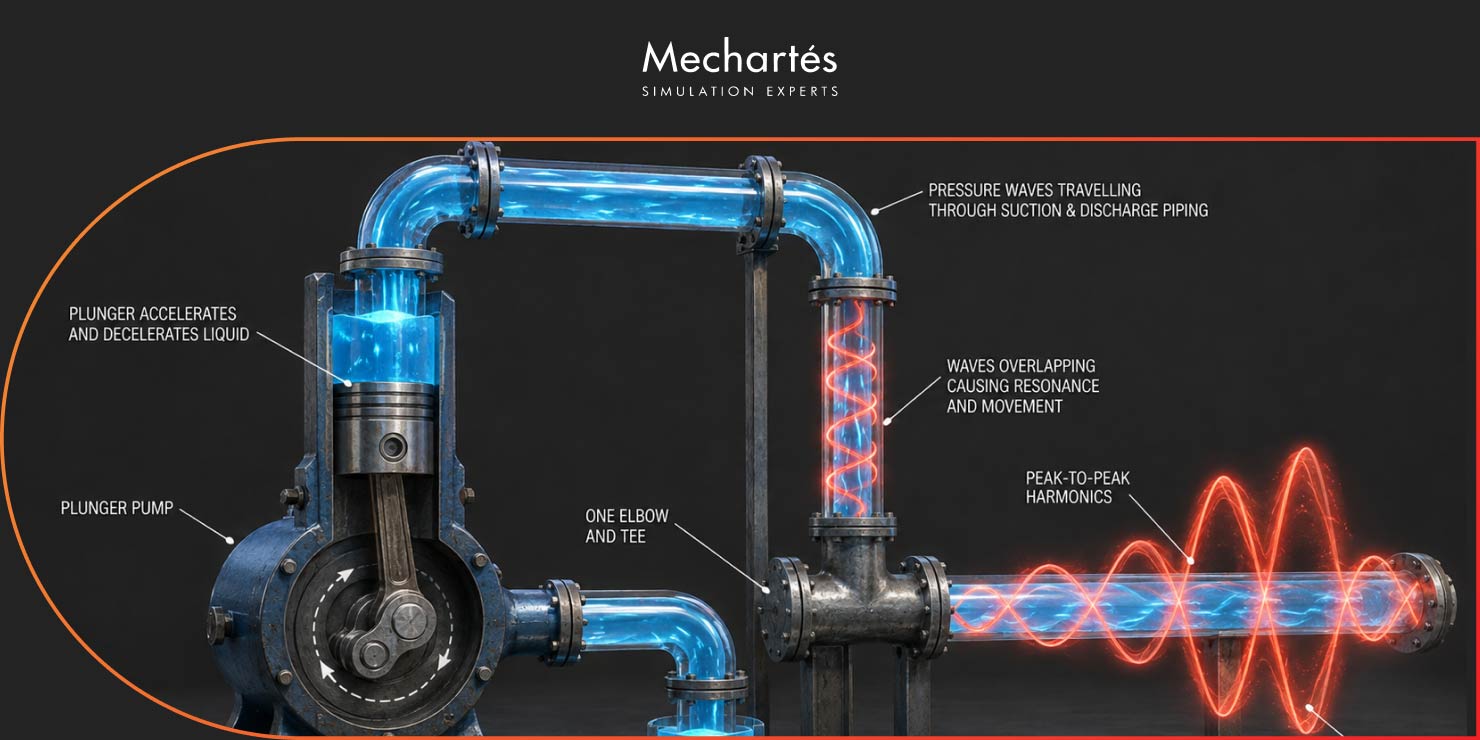
Every reciprocating plunger accelerates and decelerates the liquid during each pumping stroke. Instead of a steady flow, the pump delivers a pulsating one, and those periodic changes generate pressure waves that travel through both the suction and discharge piping of the pumping system.
What those waves look like depends on a handful of factors: pump operating speed, number of plungers, pump excitation frequency, harmonic frequencies, and the acoustic characteristics of the piping itself. A common misconception is that the highest pulsation always shows up at the pump’s running speed, 1× RPM. In reality, the most severe pressure fluctuations often occur at higher harmonic frequencies, driven by acoustic resonance within the piping system rather than the pump alone.
At Mechartes, this is exactly the kind of behaviour we check for before a pumping system goes into service.

API 674 is the internationally recognized standard governing reciprocating positive-displacement pumps used in petroleum, petrochemical and natural gas applications. One of its primary objectives is making sure pressure pulsations from reciprocating pumps don’t compromise the reliability of the pumping system.

To achieve that, the standard recommends Design Analysis Approach 2, or DA2, which evaluates both the hydraulic and mechanical response of the complete pumping system under dynamic operating conditions. Unlike conventional hydraulic calculations, DA2 looks at how pressure waves interact with the piping and flags potential operational issues before commissioning, rather than after.
DA2 includes acoustical simulation of both the suction and discharge systems. It evaluates pressure pulsation, suction pressure margin, discharge pulsation, relief valve margin, and shaking forces, and includes a mechanical restraint and span review to avoid vibration response across the pumping system. The output isn’t a simple pass or fail either. It comes with dampener, piping, and support recommendations specific to the layout being reviewed.

The suction side is often the most sensitive part of a plunger pump system. Steady NPSHA isn’t enough on its own, because suction pressure fluctuates dynamically rather than holding still. Negative pulsation peaks can reduce the instantaneous suction pressure, and if that instantaneous pressure approaches the liquid’s vapor pressure, cavitation risk goes up. Suction dampener design and suction line layout become critical at that point, not optional extras.

The standard’s suction acceptance criteria come down to a few checks: the minimum suction complex pressure wave at the inlet reference point, keeping minimum suction pressure above the highest liquid vapor pressure with adequate margin, and accounting for entrained or dissolved gas, which can alter cavitation behaviour in ways a simple hydraulic check won’t catch.
For this project, initial hydraulic calculations indicated the available NPSH was adequate and the suction system appeared acceptable. Our API 674 DA2 acoustic simulation told a different story. It showed that negative pressure peaks generated during pump operation reduced the instantaneous suction pressure to a level approaching the liquid’s vapor pressure, a risk the steady-state calculation had no way of catching.
The risk that created was cavitation, valve damage, noise, and a loss of performance further down the line. The fix was suction dampener optimization along with a suction line layout review. The lesson carries beyond this one project: suction-side dynamic pressure has to be checked on its own terms, not assumed safe because steady NPSH looks fine.
Without this analysis, the issue would likely have gone unnoticed until commissioning or early operation, at which point it’s a field problem rather than a design fix. That’s why we treat API 674 DA2 as standard practice on reciprocating pump packages, not an optional add-on for a pumping system handling reciprocating pumps.
The gap between a steady-state NPSH check and an acoustic simulation of the full pumping system can be the difference between a design that looks fine on paper and one that actually holds up in service. This is the same gap we’ve flagged in other pulsation and mechanical vibration studies, where a piping system that passed conventional checks still showed pulsation problems once modelled properly, and it’s why we pair DA2 with a broader root cause review whenever a system shows unexplained noise, vibration or wear.
We’ve reviewed enough reciprocating pump packages and their support and restraint requirements to know where the hidden risks usually sit, and it’s rarely where the steady-state numbers say it should be, a pattern we’ve also seen on similar API 674 projects across the region, including work we’ve done in Australia.
If you’re evaluating a pump package and want a second opinion on the suction side, get in touch with the team at Mechartes.