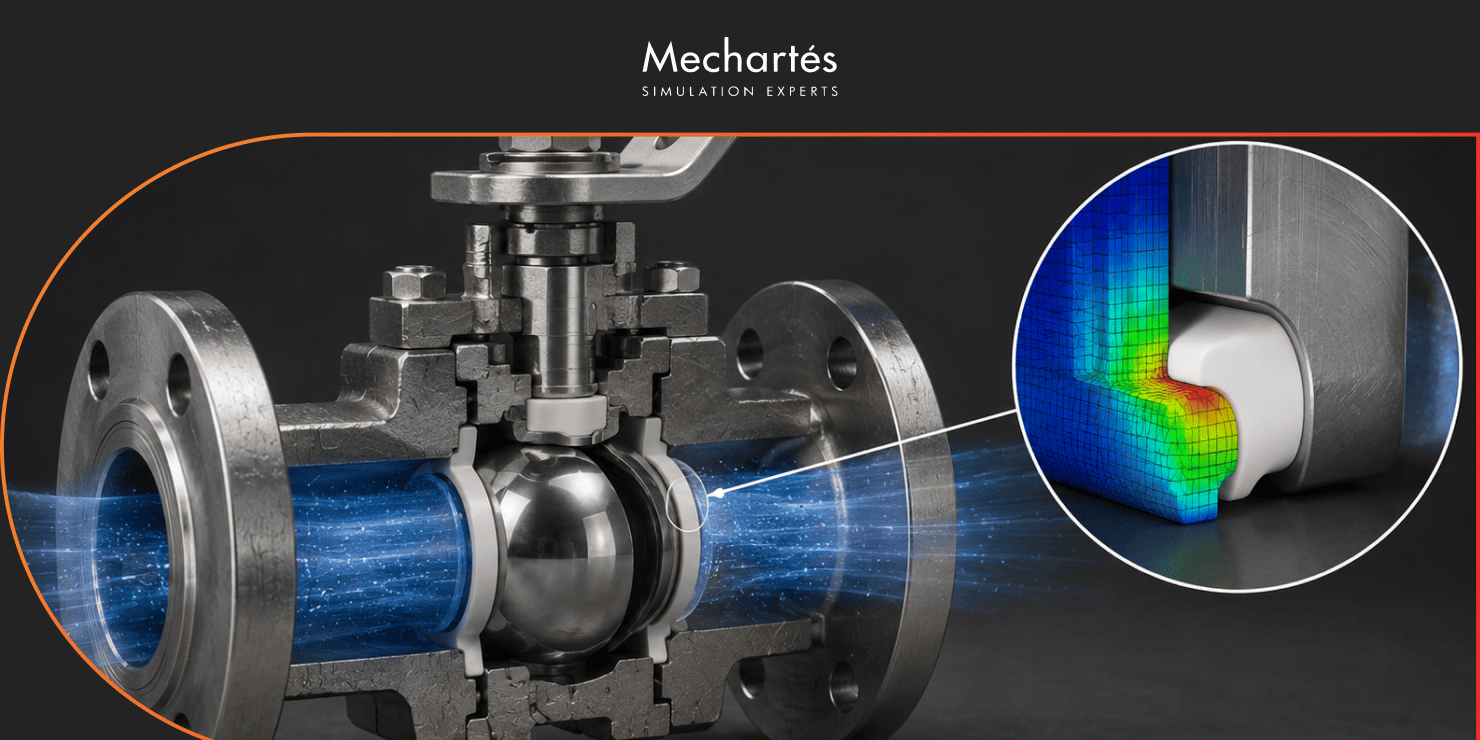
Most seal failures in high-pressure valve applications don’t start with a fracture. They start with a loss of contact at the sealing interface. Once that contact breaks down, even partially, a leak path opens up, and by the time it shows up on site, the seal has usually been struggling for a while.
Working out what sustains that contact under real operating conditions isn’t something a static review can answer. Installation preload, thermal expansion and operating pressure all act on PTFE at once, and their combined effect is exactly the kind of problem simulation is built for, the same way flange leakage and gasket sealing checks depend on more than a static calculation.
At Mechartes, we recently completed an FEA study for Mithson Sealing Solutions on a spring-energized PTFE lip seal used for ball valve stem sealing in a high-pressure application. This article walks through what it found.
At pressures exceeding 440 bar and temperatures up to 150°C, the seal gets compressed during installation, expands as temperature rises, and deforms further as operating pressure builds. Through all of that, the sealing lip has to keep continuous contact with the stem.
PTFE’s mechanical response shifts substantially with load and temperature, and the deformation it picks up during service directly changes its sealing behaviour. None of that shows up in a static geometry check, which is why this needed simulation rather than hand calculations, the kind of work our broader engineering services team handles across sealing and pressure equipment.
We built a model to replicate the loading sequence the seal experiences in service: installation preload, pressure build-up, elevated temperature and hydrotest, assessed individually and in combination. The focus stayed on contact pressure at the sealing interface across the full sequence, the same approach we bring to FEA consulting work across oil and gas equipment. Two configurations went into the comparison, with and without the internal spring energizer, to isolate its contribution at low and zero pressure.
The seal held continuous contact with the stem across every condition the analysis covered. At the primary operating condition of 440 bar and 150°C, the sealing interface stayed fully engaged with no lift-off, and the hydrotest condition produced a larger sealing margin than standard operation, consistent with the standards our FEA consulting work is built around.
Operating pressure reinforced the seal rather than working against it. As process pressure rose, contact pressure at the interface rose with it, consistent with the pressure-energization mechanism built into this seal geometry, with the highest contact forces at peak operating pressure. The FEA also confirmed significant plastic deformation in the PTFE during operation, alongside maintained sealing integrity. For a PTFE seal, contact pressure at the interface is the relevant performance measure, not stress, and that deformation is part of how the seal works under load.
At normal operating pressure, both configurations came out similar, since pressure energization dominated and the spring added relatively little extra contact pressure. At low and zero pressure, the two diverged sharply. During startup, shutdown, or any transient before process pressure builds up, the spring energizer was the primary source of sealing contact force, and without it, the analysis couldn’t confirm adequate sealing contact.
The spring’s real job is holding contact during low-pressure phases, not adding performance at peak pressure. For valves with frequent cycling or extended low-pressure periods, leaving it out changes the sealing picture considerably.
For metallic sealing components, stress-based criteria are usually enough. For PTFE, they’re not, since the material deforms plastically under sustained load and the seal geometry keeps changing through service. Contact pressure drops over time from creep and stress relaxation under sustained temperature and pressure, which is why fatigue life prediction and long-term analysis matter as much as the initial design check.
The real durability question isn’t whether stress margins look fine at installation. It’s whether enough contact pressure remains at the interface after years of cycling, and that has to feed into design margins and inspection intervals from the start.
The FEA confirmed reliable sealing contact across every condition tested, with the spring energizer carrying low-pressure performance and pressure energization taking over once the valve is in service. What happens after that, as contact pressure evolves with creep and stress relaxation over years of cycling, belongs in the design input, not something worked out after a leak shows up in the field.
If you’re working through a similar sealing evaluation or pressure-containing equipment design, get in touch with the team at Mechartes.