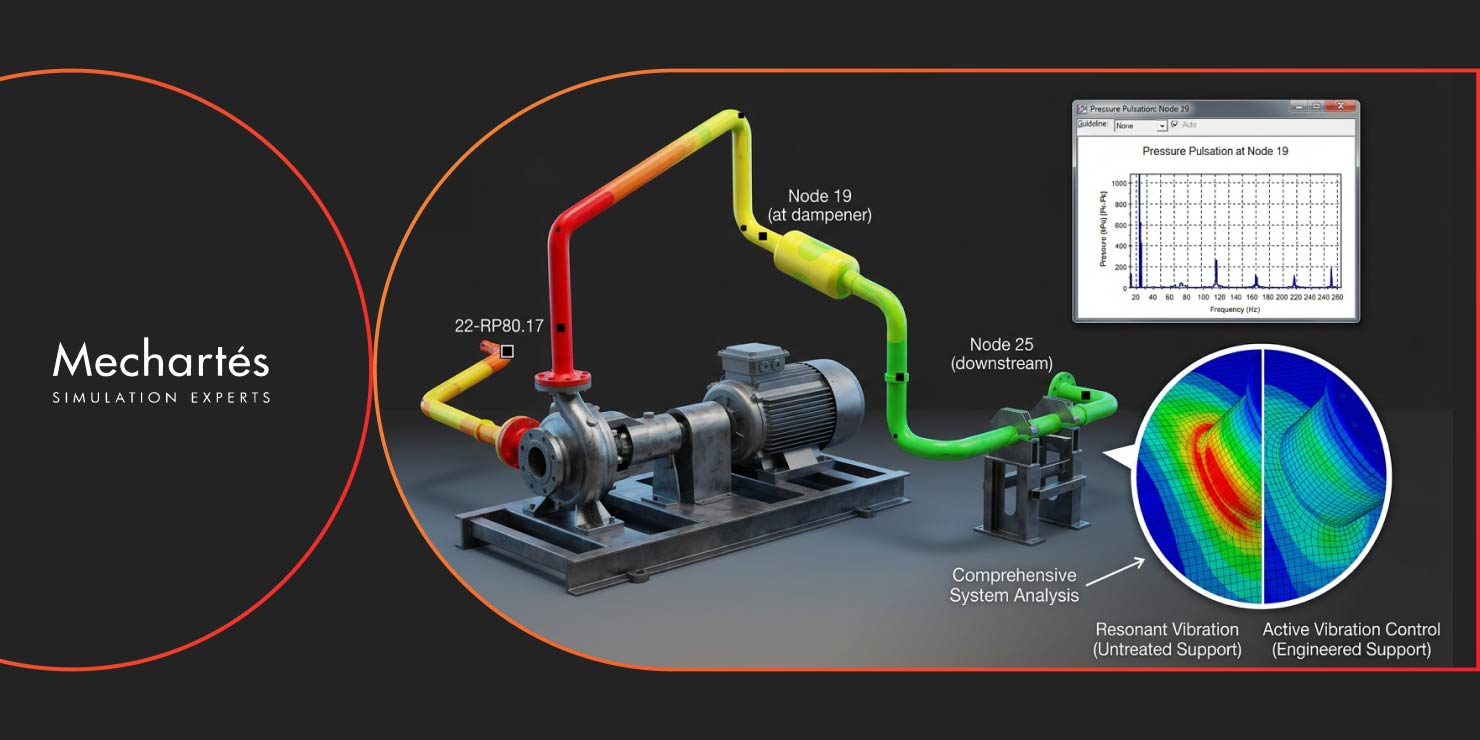
When working with reciprocating pumps in high-pressure or complex systems, pulsation and vibration represent more than technical considerations on a design checklist. These phenomena directly impact equipment life, trigger premature failures, and cause unplanned downtime. The challenge is that many systems experience these problems because they weren’t addressed properly during the design stage, and remediation after installation consistently costs more than prevention would have.
This article examines the engineering principles behind pump pulsation, its root causes, and the analysis-driven approaches that ensure safe, efficient pumping system design.
Pulsation is inherent to reciprocating pump operation. The reciprocating motion creates distinct intake and discharge phases, resulting in a pulsing stream rather than steady flow. This is fundamental to positive displacement pump physics.
However, from a system design perspective, pulsation isn’t isolated to the pump itself. It’s a system-level phenomenon. When pulsation becomes excessive, the consequences manifest throughout the installation: pipe vibration, fatigue failures, noise issues, instrument malfunctions, seal damage, and premature valve failures. The pulsation propagates as acoustic waves through the piping system, creating both flow ripple and pressure fluctuation.
Several critical aspects define pulsation behavior. Harmonic content occurs at the pump’s running speed and its multiples, with amplitude depending on the number of plungers and specific pump design characteristics. Acoustic resonance develops when pulsation frequencies align with the natural acoustic frequencies of the piping network, sometimes creating dramatic amplification that exceeds design limits. Standing waves form when reflections at dead ends, vessels, or closed valves magnify pressure pulsations significantly, creating nodes and antinodes throughout the system.
The two types of reciprocating pumps where pulsation phenomena are most pronounced are API 674 pumps (reciprocating piston or plunger types suited for high-pressure, low-flow applications) and API 675 pumps (controlled-volume metering or diaphragm pumps where precision and repeatability are critical).
Many projects rely on standard empirical approaches: catalog dampener sizes, generic pulsation bottle volumes, and vendor “proven” layouts. These methods work adequately in simple, low-pressure systems. However, they consistently fail in complex, high-pressure, or geometrically challenging applications.
Static sizing methodologies ignore several critical factors. They don’t account for the interaction between pump harmonics and piping acoustics, operating condition variability and its effect on system response, the dynamic behavior of valves and dampeners under actual conditions, or acoustic interference patterns in complex piping networks.
The result is systems with dampeners installed that still vibrate excessively, leading to costly retrofits, unplanned shutdowns, and sometimes catastrophic failures. Multiple remediation projects demonstrate that initial designs relying on empirical methods required post-installation fixes that far exceeded what proper upfront analysis would have cost.
Pulsation analysis is required or strongly recommended for systems requiring API 674 or API 675 compliance, high-pressure or high-power reciprocating pumps, long or geometrically complex piping layouts, installations with sensitive instrumentation or fatigue-critical piping, existing systems exhibiting vibration or performance issues, and offshore or remote installations where failure consequences are severe.
At Mechartes, we conduct pulsation studies in accordance with applicable industry standards. For API 674 applications, we ensure systems meet specified pulsation limits at various measurement points throughout the installation. API 674 defines acceptable vibration limits for reciprocating pumps, while API 675 addresses vibration limits specifically for diaphragm pumps.
These standards exist because the industry has documented what happens when pulsation is ignored or inadequately addressed. Analysis methodology must ensure compliance not just on paper, but under actual operating conditions.
Mechanical vibration analysis evaluates the oscillatory motion of equipment components to detect irregularities or faults before they become failures. Vibrations stem from imbalance, misalignment, wear, bearing degradation, or resonance conditions.
Modal analysis identifies natural frequencies and vibration modes through finite element analysis. If the pump’s excitation frequency matches the system’s natural frequency, resonance occurs, leading to excessive vibrations and accelerated failure. The goal is straightforward: ensure the system doesn’t operate at those frequencies. This requires rigorous analysis to implement correctly.
Dynamic stress evaluation assesses stress levels under dynamic loading conditions to ensure they remain within allowable limits for the material and service conditions. Experience across petrochemical, upstream oil and gas, and industrial facilities shows that proper vibration analysis consistently identifies issues that would have led to failures in the first year of operation.
When systems are modeled properly, common findings include excessive pressure pulsation at pump nozzles exceeding API limits, high dynamic forces causing pipe vibration and support overload, resonance conditions near dominant pump harmonics, incorrect dampener pre-charge pressure or suboptimal placement, poor pulsation dampener location, acoustic interference creating amplification zones in the piping, and insufficient or improperly designed pipe supports.
Most of these issues remain invisible through static calculations or layout reviews alone. They require acoustic modeling, frequency domain analysis, and time-domain simulation to identify and resolve.
Effective pulsation control requires an analysis-driven approach rather than catalog-based device selection. Solutions implemented at Mechartes include optimizing pulsation dampener locations, installing orifice plates, and modifying pipe layouts. Placement matters as much as the device itself.
Pulsation dampeners must be engineered to absorb or reduce pressure fluctuations at specific frequencies. This requires modeling dampener performance within actual system acoustics to ensure effectiveness. Generic sizing routinely fails because it ignores system-specific acoustic characteristics.
Piping modifications change pipe dimensions, lengths, or routing to shift system resonance frequencies away from pump pulsation frequencies. This requires acoustic modeling but works reliably when properly executed.
Support design must account for dynamic loads, not just static weight. Numerous remediation projects have addressed support failures that occurred because only static loading was considered in the original design.
As pumping systems become more compact, operate at higher pressures, and push performance boundaries, pulsation-related risks increase proportionally. Modern engineering practice demands analysis-based design rather than assumptions or rules of thumb that may have worked in simpler applications.
When pulsation and vibration are addressed at the design stage and validated through proper analysis, the result is reliable, safe, long-lasting pump systems. From an engineering standpoint, effective pulsation control isn’t optional. It’s fundamental to system integrity and operational reliability.
At Mechartes, we work with pump OEMs, EPCs, and end users across oil and gas, petrochemical, power generation, and industrial sectors to deliver comprehensive pulsation and vibration analyses. Our studies translate directly into safer, quieter, more reliable pumping systems because addressing these issues properly during design consistently costs less than fixing failures after commissioning.
Ready to discuss pulsation analysis for your reciprocating pump systems? Contact us to explore how proper analysis can protect your investment and ensure long-term system reliability.