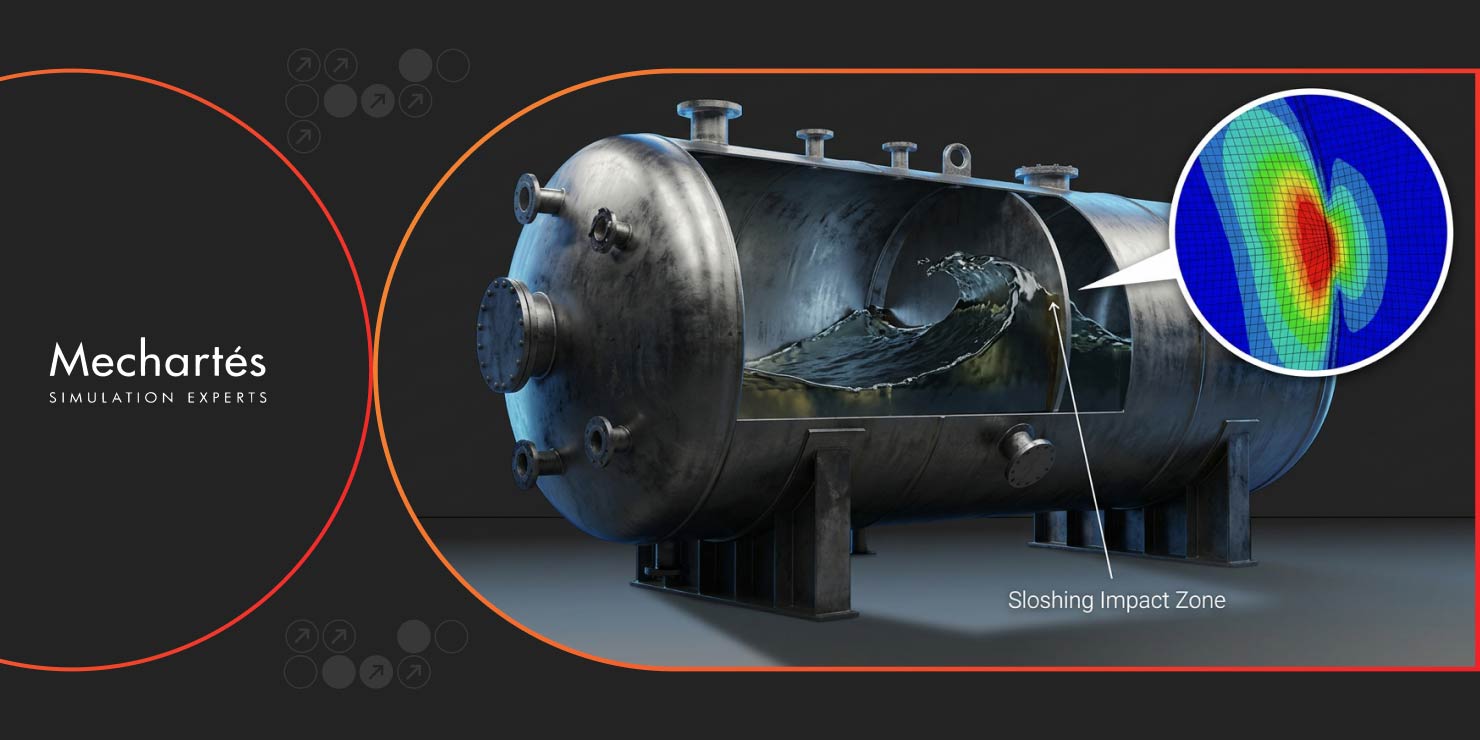
Offshore platforms don’t sit still. They pitch, roll, and heave with wave motion, and every piece of equipment on board moves with them. For process equipment like separators, tanks, and vessels that contain liquids, this constant motion creates a phenomenon called sloshing that can significantly impact performance and structural integrity.
Sloshing occurs when the liquid inside a partially filled container responds to the external motion of the vessel. The fluid sloshes back and forth, creating dynamic pressure loads on internal structures, affecting separation efficiency, and potentially causing mechanical damage if the forces exceed design limits.
For critical offshore equipment, particularly on Floating Production Storage and Offloading (FPSO) vessels, understanding sloshing behavior isn’t optional. It’s essential for ensuring equipment performs as designed under real operating conditions.
FPSOs operate in dynamic offshore environments where wave-induced motion is constant. Unlike onshore facilities, where process equipment operates under relatively stable conditions, offshore separators, storage tanks, and other vessels must maintain performance while experiencing significant acceleration forces.
The challenges this creates are substantial. Separation efficiency can degrade when the liquid interface becomes unstable due to motion. Internal components like vane packs, baffles, and weir plates experience cyclic loading that wasn’t present in static design analysis. Pressure distributions change dynamically, creating stress concentrations that can lead to fatigue.
Traditional static analysis methods can’t capture these effects. They assume stable operating conditions that simply don’t exist offshore. This is where computational fluid dynamics (CFD) with motion and sloshing analysis becomes necessary.

Motion analysis using CFD simulates how the fluid behaves when the entire vessel undergoes the pitch, roll, and heave motions typical of offshore installations. The simulation applies realistic motion profiles based on sea state data and vessel characteristics, then solves the fluid dynamics equations to show exactly how the liquid responds.
This reveals several critical aspects of equipment performance that static analysis misses.
When liquid sloshes inside a vessel, it creates forces on internal structures. These aren’t constant forces but dynamic loads that vary with the motion frequency and amplitude. CFD coupled with structural analysis (fluid-structure interaction, or FSI) shows how internal components respond to these loads.
For separator internals, this analysis identifies whether baffles, vane packs, and support structures can withstand the dynamic loading. It maps stress concentrations and deflections that could lead to fatigue failure or interference with other components.
Offshore separators typically handle multiphase flows (gas, liquid hydrocarbons, and water). Under motion conditions, the phase interfaces become dynamic. Gas can be entrained in the liquid phase, liquid can carry over into the gas outlet, and the water-oil interface can become unstable.
CFD simulations track how each phase behaves under motion, showing whether the separator maintains adequate phase separation efficiency or whether design modifications are needed to improve performance.
Perhaps most importantly, motion analysis shows whether the equipment meets its performance guarantees under actual operating conditions. A separator might work perfectly on the test stand but fail to meet specifications when installed on an FPSO experiencing typical sea states.
The simulation provides quantitative data on separation efficiency, pressure drop, liquid carryover, and other performance parameters under the full range of expected operating conditions.
Mechartes recently completed a comprehensive motion and sloshing CFD analysis for a major LNG project in Africa. The work focused on an FPSO inlet separator that needed to maintain performance under the dynamic offshore conditions typical of the installation location.
The project required several interconnected simulation studies to fully characterize separator performance.
We executed a comprehensive motion and shaking analysis that incorporated fluid-structure interaction. This simulated the complete system response, including how the liquid moved inside the separator and how those movements created forces on the internal structures.
The multiphase flow simulation evaluated separator performance across the range of expected operating conditions. This included different liquid levels, flow rates, and gas-to-liquid ratios, all under dynamic motion conditions.
The analysis verified several critical aspects of the separator design.
Gas performance with the designed internals was confirmed across all operating scenarios. The vane packs and other gas-liquid separation devices maintained their effectiveness even under significant vessel motion.
Structural integrity of internal components was validated through the FSI analysis. The baffles, supports, and other structures showed acceptable stress levels and deflections under the dynamic loading conditions.
Phase separation efficiency remained within acceptable limits. While motion does impact separation performance compared to static conditions, the design maintained adequate margins to meet process requirements.
The project culminated in securing Code A approval, which confirms the design’s compliance with international standards for offshore equipment. This approval validates that the separator will perform safely and effectively under the specified operating conditions.
Code A approval requires demonstrating compliance through detailed engineering analysis, which in this case meant providing comprehensive CFD results showing separator performance under realistic motion conditions. The analysis documented not just that the equipment would work, but exactly how it would perform across the full operating envelope.
Not every offshore vessel requires detailed motion and sloshing analysis. The decision to perform this level of simulation depends on several factors.
Critical equipment with tight performance requirements typically needs motion analysis. If separation efficiency, liquid carryover limits, or other specifications have small margins, you need to understand how motion impacts performance.
Large vessels or tanks with significant liquid volumes can develop substantial sloshing forces. The larger the liquid mass and the longer the sloshing period, the more important it becomes to analyze the dynamic behavior.
Novel designs or unusual operating conditions also warrant detailed analysis. If the equipment configuration differs from proven designs, or if the offshore location has particularly challenging sea states, simulation helps validate performance before fabrication.
At Mechartes, we combine CFD expertise with understanding of offshore operational requirements to deliver simulation solutions for critical applications. Our work on projects like this LNG FPSO separator demonstrates the value of comprehensive analysis in validating equipment performance under real-world conditions.
Motion and sloshing analysis, multiphase flow simulation, and fluid-structure interaction studies provide the detailed insights needed to ensure offshore equipment performs as designed throughout its operational life.
Ready to discuss motion and sloshing analysis for your offshore equipment? Contact us to explore how CFD simulation can validate performance and support regulatory approval for your critical installations.