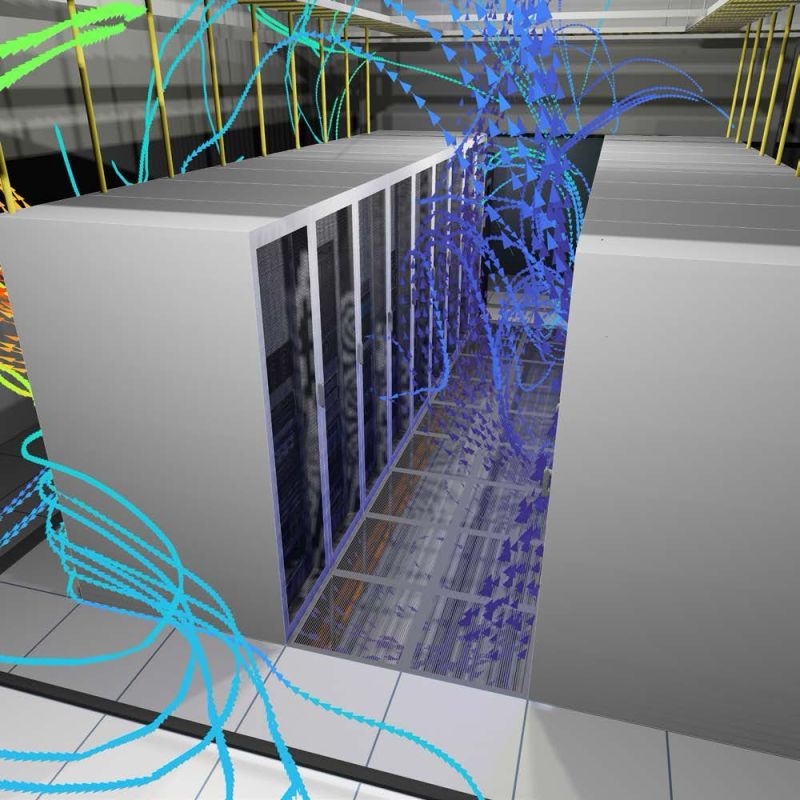
Data center cooling has always been a challenge, but the stakes have changed. With higher rack densities, AI workloads pushing thermal limits, and sustainability pressures mounting, getting cooling wrong doesn’t just mean discomfort. It means downtime, wasted energy, and operational costs that spiral out of control.
The traditional approach to data center design involves calculations, assumptions, and some educated guesses about how air will move through your facility. You build it, commission it, and hope the cooling performs as designed. Sometimes it does. Often it doesn’t, and you’re left troubleshooting hotspots and inefficiencies in a live production environment.
Digital twin technology changes this equation by letting you see how your data center will perform before you build it, and continuously optimize it after it’s running.
A digital twin is a virtual replica of a physical environment that behaves like the real thing. For data centers, this means creating a precise 3D model that simulates airflow, temperature distribution, equipment heat loads, and cooling system performance under different operating conditions.
Unlike static design drawings or spreadsheet calculations, a digital twin is dynamic. It uses computational fluid dynamics (CFD) to model how air actually moves through the space, accounting for the complex interactions between cooling units, server racks, hot and cold aisles, and the building envelope.
The technology behind modern digital twins has evolved significantly. Platforms like Cadence Reality DC Design Pro use 6Sigma Digital Twin technology to create highly accurate simulations that can predict thermal behavior down to specific rack locations and individual equipment hotspots.
This isn’t just about pretty visualizations. The simulations are physics-based models that calculate heat transfer, fluid flow, and energy consumption with the kind of precision that lets you make confident design decisions.
The value of digital twin technology shows up in three critical areas where cooling strategy directly impacts data center performance and economics.
Hotspots are one of the most common and expensive problems in data center operations. A single rack running hot can trigger temperature alarms, force equipment into thermal throttling, or even cause failures that take critical systems offline.
Traditional design approaches struggle to predict where hotspots will occur because they can’t account for all the variables. How does air recirculate in that corner near the structural column? What happens when you add high-density racks to an area that was designed for lower loads? How does the cooling distribution change when you lose a CRAC unit?
Digital twin simulations answer these questions before they become problems. You can model different equipment layouts, cooling configurations, and failure scenarios to identify potential hotspots and address them in the design phase rather than during emergency maintenance.
Energy consumption for cooling typically represents 30-40% of total data center power usage. Even small improvements in cooling efficiency translate to significant operational savings and reduced environmental impact.
Digital twins let you test different cooling strategies virtually. Should you use hot aisle containment, cold aisle containment, or both? What supply air temperature gives you the best balance between cooling capacity and energy efficiency? How should you sequence multiple cooling units to maintain coverage while minimizing power consumption?
By simulating these scenarios, you can optimize your cooling strategy based on actual performance rather than vendor specifications or rule-of-thumb assumptions. The simulations show you not just whether a configuration works, but how efficiently it works under different load conditions.
Beyond cooling efficiency, digital twins help identify opportunities to reduce overall power consumption through better design decisions. This includes optimizing air distribution to eliminate over-cooling, right-sizing cooling equipment to match actual loads rather than worst-case scenarios, and identifying areas where free cooling or other efficiency measures can be deployed.
For facilities targeting sustainability goals or operating under power constraints, these optimizations can make the difference between meeting targets and falling short.
At Mechartes, we’ve added Cadence Reality DC Design Pro to our engineering toolkit specifically to strengthen our data center design and optimization capabilities. This platform integrates with our existing CFD, FEA, and thermal analysis expertise to provide clients with comprehensive simulation-based solutions.
The 6Sigma Digital Twin technology allows us to create precise 3D models of data center environments that account for all the factors that influence thermal performance. We can simulate internal data hall conditions, external environmental factors, and the flow network connecting them in a single integrated model.
This capability is particularly valuable for complex projects where traditional analysis methods struggle. High-density deployments, mixed cooling architectures, retrofits of existing facilities, and designs with unusual architectural constraints all benefit from the detailed insights that digital twin simulation provides.
We use these models throughout the project lifecycle. During design, they help validate cooling strategies and identify optimal equipment layouts. During commissioning, they provide a baseline for comparing actual performance against predicted behavior. And during operations, they support ongoing optimization as loads and configurations evolve.
The data center industry is moving toward higher densities, more demanding workloads, and stricter efficiency requirements. Meeting these challenges requires moving beyond traditional design approaches that rely on safety margins and conservative assumptions.
Digital twin technology provides the visibility and precision needed to make confident decisions about cooling strategy. You can test designs virtually, identify problems before they occur, and optimize performance based on actual physics rather than educated guesses.
At Mechartes, we combine digital twin capabilities with deep expertise in CFD, FEA, piping, vibration, and acoustic analysis to deliver comprehensive solutions for complex data center challenges. This integrated approach ensures that cooling strategies work not just in isolation but as part of the complete facility design.
Ready to optimize your data center cooling strategy with digital twin technology?
Contact us to discuss how simulation-based design can improve performance and reduce risk for your next project.