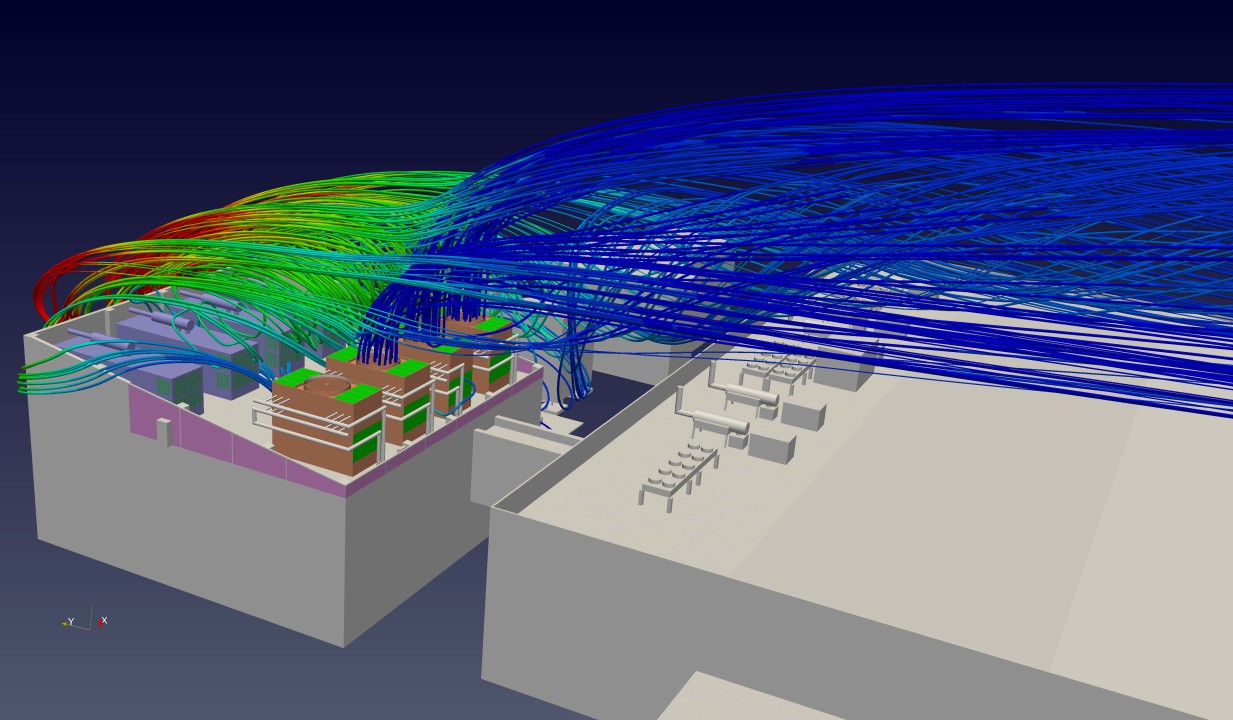
Data center facilities use chillers to cool the water circulating through their heating, ventilation, and air conditioning systems. Because many servers operate close to one another, chillers must run around the clock to maintain data center operation.
These facilities have several mechanical units, including chillers, ODU units placed on the roof, and generators emitting hot flue gas at very high temperatures. In the design phase, it is critical to analyze how hot air impacts the chillers’ performance and implement measures to reduce it.
Additionally, it is vital to study the dispersion of pollutant emissions in nearby pedestrian areas by analyzing flue gas properties, including NOx and SOx levels.
A comprehensive external CFD (Computational Fluid Dynamics) analysis addresses these challenges. With proper analysis, thermal recirculation can be quantified, and emission levels can be verified before construction begins.
In this article, we’ll explore how external CFD analysis works and examine the findings from a data center project where this analysis proved essential.
External CFD analysis for data centers involves simulating airflow, temperature distribution, and pollutant dispersion in the outdoor utility yards. For various wind directions and ambient conditions, engineers can study the performance of chillers and mechanical units using CFD analysis.
The analysis process typically involves these aspects:

Engineers create accurate three-dimensional models of the complete facility based on design drawings. This includes modeling nearby buildings in a CFD wind tunnel configuration, and all obstructions including pipes, walls, and equipment within the data center building. Chillers, mechanical units, generators, and air intake louvers are modeled in detail.
Appropriate boundary conditions are applied, including intake and discharge temperature and velocity from all equipment. Wind and ambient conditions are selected based on project requirements and site location.
Steady-state CFD simulations are performed to study velocity, temperature, and recirculation on each piece of equipment.
The mechanical equipment in a data center utility yard produces significant thermal loads. Water chillers discharge hot air, backup generators emit exhaust at very high temperatures, and various mechanical units contribute to the overall heat rejection in a relatively confined space.
Without proper analysis during the design phase, hot air from equipment discharge can recirculate back into equipment inlets, degrading performance when it matters most. When chillers pull in air that has already been heated by other equipment, efficiency drops and cooling capacity decreases.
Environmental compliance is equally critical. Generator exhaust contains NOx and SOx emissions that must be evaluated, particularly when data centers are located near residential areas or occupied buildings. NO2 impacts must be checked against the project’s applicable ambient-air compliance criteria (which vary by jurisdiction and averaging time), especially where nearby receptors are residential or occupied buildings.
The main objectives of CFD analysis for project owners, contractors, and design consultants include:
Mechartes recently completed an external CFD analysis for a data center project that revealed critical design considerations requiring modification before construction.
Based on inputs and design drawings, a detailed 3D model of the complete facility was prepared in CFD software. A CFD wind tunnel was created by modeling nearby buildings. Within the data center building, all obstructions, including major pipes, wall structures, and equipment, were modeled. Chillers, mechanical units, generators, and air intake louvers received detailed modeling attention.
Boundary conditions including intake and discharge temperature and velocity from all equipment were applied. Wind and ambient conditions were selected per project requirements and site location.
Upon completion and approval of the 3D model, steady-state CFD simulations were performed to study velocity, temperature, and recirculation on each piece of equipment.
The analysis revealed considerable temperature increases at the inlets of chillers and other mechanical units, which impacted performance. Recirculation calculations found that approximately 5% to 50% of air recirculated depending on equipment location and wind conditions.
This recirculation occurred primarily due to hot air movement from the generator and chiller outlets toward the inlets of chiller units. The facility layout, while optimized for space, created conditions where thermal plumes would linger rather than disperse.
The CFD results also showed that NO2 emissions from generator exhaust affected the data center building premises and nearby high-rise buildings. The NO2 levels exceeded acceptable limits under certain operating conditions.
To prevent high-temperature generator discharge air from moving toward the inlets of generators, chillers, and other equipment, revised CFD studies were conducted with the installation of vertical ducts. These ducts released discharge and exhaust air at a higher elevation from ground level.

To prevent hot air emitted from chiller discharge from returning to chiller inlets and reduce recirculation, canopies were constructed between units. These thermal barriers blocked horizontal hot air movement while maintaining adequate ventilation.
The revised CFD simulations confirmed these modifications effectively solved the identified problems. Temperature increases at equipment inlets dropped to acceptable levels, recirculation percentages fell below critical thresholds, and NO2 concentrations came within regulatory compliance limits.
External CFD analysis during the design phase is essential for preventing thermal recirculation and ensuring environmental compliance in data center facilities. The analysis quantifies specific performance impacts, identifies problem areas, and validates design modifications before construction begins.
Implementing solutions like vertical exhaust extensions and thermal barriers during design is significantly more cost-effective than retrofitting after construction, while ensuring equipment operates at design efficiency throughout the facility’s lifespan.
Mechartes has completed external CFD analyses for data center projects across multiple continents, delivering precise simulation solutions for complex thermal management challenges.
To learn more about external CFD analysis for your data center project, contact our team.